FIGHTING THE INFLUENCE OF TROPHY KILLING INTERESTS ON WILDLIFE AND WILDLIFE MANAGEMENT
The Wildlife Code is a 501(c)(3) public charity recognized as tax-exempt by the IRS
The Wildlife Code
Even if you think there are larger, more pressing policy priorities than wildlife management and conservation, the crisis unfolding around wildlife right now reaches directly into your life. Science-based management and balance that protect wildlife, the wild places in which they live and sustain and the people who depend on them are under attack. Unethical trophy killing and poaching are mounting, and the warning signs are impossible to ignore. When those charged with enforcing our wildlife laws fail to act decisively, when the state allows trophy killers to drive policy, the damage spreads far beyond individual animals. It undermines public trust, threatens our wildlife, ecosystems, habitat, and our climate and water while also weakening the rule of law, public representation, and puts all of life at risk.
Wildlife is not a luxury or a side issue. It is the living foundation of clean water, healthy forests and grasslands, resilient agriculture, disease control, and climate stability. When enforcement collapses and science is abandoned in lieu of favoring trophy killers, unethical and illegal killing becomes emboldened, ethical standards are pushed aside, and the systems that sustain us begin to unravel. This is not happening in some remote wilderness—it is happening on the land that feeds our communities, supplies our water, and shapes our outdoor and wildlife tourism economy.
When wildlife protections fail, everyone pays the price. Communities lose the natural safeguards that protect public health. Law‑abiding hunters and conservationists are betrayed. As lifelong Montanans are seeing now, each succeeding generation inherits a depleted landscape and distressed and diseased wildlife, instead of a thriving wild places and wildlife. Wildlife policy, at its core, is about accountability, about whether those entrusted to protect our shared natural heritage will uphold that responsibility or allow it to be stripped away. The question before us is no longer whether the crisis threatening our wildlife matters, but whether we are willing to demand action before the damage becomes irreversible.
Policy decisions shape the future of Montana’s wildlife, landscapes, ecosystems, and public trust.
The Wildlife Code examines how laws, regulations, and political decisions influence the management of Montana wildlife and the public lands upon which they depend.
Federal rollbacks and state wildlife management policy that contradicts science and public interest
results in harm to wildlife, to ecosystems, habitat, climate and to all of us.
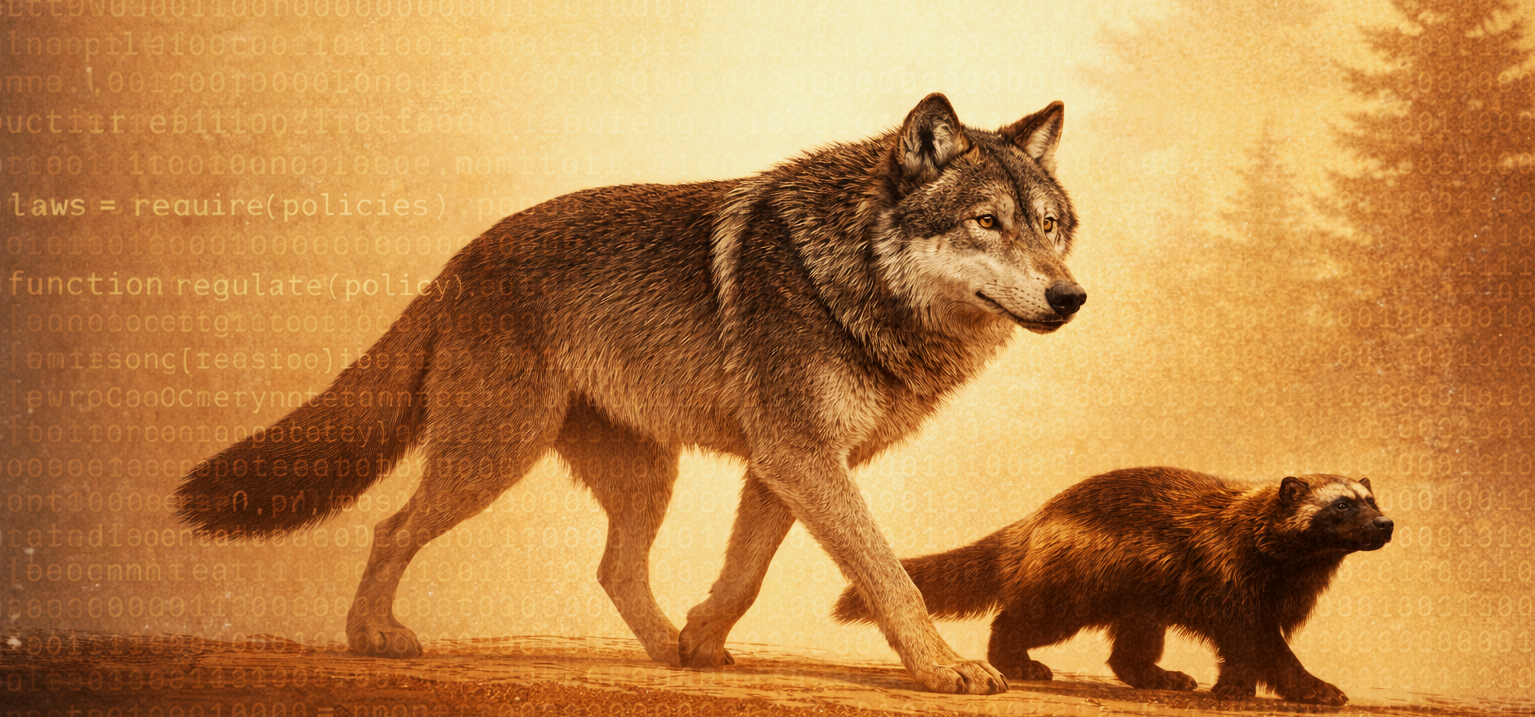
Montana’s predator species - gray wolves, grizzly bears, wolverines, lynx, mountain lions and more —
are increasingly managed under aggressive, lethal policies that conflict
with science, law, and the public interest.
Wildlife belongs to all of us, held in trust for the people
and for future generations.
The Wildlife Code fights to protect that trust.
Our name refers to the federal, state and agency policies that determine how wildlife is managed in Montana – i.e. who makes the decisions, whose voices are heard - whose are not - whether science and nonconsumptive use of public lands are considered, and whether or not best available science and transparency guides the outcome. These decisions shape everything from habitat protection and disease response to recreational opportunity and long-term population health.
At its most literal level, The Wildlife Code refers to the Montana Code Annotated - the body of law that establishes how wildlife is managed, who makes those decisions, and what responsibilities the state holds to the public. Wildlife in Montana is not privately owned; it is held in trust for the people - not trophy killers and wealthy landowners. The legal code governing that trust carries real consequences for ecosystems, wildlife, water, landscapes, and future generations. But “code” also carries other meanings that have long been part of Montana’s relationship with wildlife.
ethical code
Montana has a history of monied interests abusing our lands and those in positions of power abusing our wildlife. However, there are more of us who care about our wildlife, including Montanans who have been here for millennia, those who have been here for generations and those who came here more recently. We are all committed to upholding an ethical code based on knowledge of the unquestioned need for decisions based on best available science, love and respect for wildlife, responsibility to the water and land - and to each other. We recognize the simple truth that humans owe a moral obligation to wildlife born out of our dependence on them, out of respect and a desire to coexist to make Montana the special place that it is - and keep it that way.
The Tribes of Montana, those of us who fought superfund cleanup sites and supported a revised Montana Constitution, anglers, nonconsumptive users of public lands, ethical hunters, and others all share an unspoken code of ethics based on an understanding that wildlife should be treated with respect, restraint, and responsibility and that if you kill game, it is for sustenance – for feeding your family - not for trophies! Principles such as fair chase, following the law, pack it in - pack it out, leave it better than you found it, and stewardship of habitat reflect a shared cultural recognition that our wildlife, wild places, and wildlife management carries moral obligations as well as legal ones.
scientific code
Healthy wildlife depends on evidence-based decisions. Diseases like chronic wasting disease (CWD) and the genetic isolation of species such as grizzly bears show how populations can be harmed, sometimes permanently, when science is ignored and/or habitat is fragmented. Wildlife management must operate under another kind of code: the scientific method. Sound wildlife governance depends on policies and management practices grounded in the best available science. Ecological systems respond to disease, habitat conditions, and human pressures in measurable ways. When wildlife policy ignores scientific evidence, the consequences can reverberate over generations.
Chronic wasting disease (CWD) is a prime example of how wildlife populations are shaped by biological code. It is a fatal neurological disease affecting deer and other ungulates. Research shows that CWD creates strong selective pressure on wildlife populations by acting on variations in the prion protein gene (PRNP). Certain genetic variants can influence how susceptible an animal is to infection or how rapidly disease progresses. Over time, disease can wreak havoc within herd and a state’s population, spreading into surrounding states and other areas.
Rejection of science-based management has led to poor policy decisions leading to adverse impacts on wildlife in Wyoming where CWD has spread rampantly. By allowing unethical and aggressive policy to decimate the populations of wolves within the state, ungulate wildlife increased at first but is now becoming sparse due to spread of chronic wasting disease and depletion of vegetation and food sources. If it has not already impacted other species, it will, as some serve as a food source for apex predators upon whom all other species depend for their existence.
Together, these forces form the Wildlife Code.
We work where these systems intersect, tracking policy, exposing threats to
science-based management, and giving the public clear insight
into decisions that affect Montana’s wildlife. When the code is broken,
the consequences for our wildlife - and for us - last for generations.
Protect the Wild
Genetics plays a critical role in large carnivore conservation. Species such as grizzly bears rely on landscape connectivity that allows individuals to move between ecosystems and reproduce across populations. When habitat fragmentation or land-use decisions restrict travel corridors, genetic diversity declines. Over time, this isolation can weaken the resilience of the species, affecting what might be described as the biological code of the species itself.
In this sense, the “code” governing wildlife operates on multiple levels:
the legal code written into law,
the ethical code guiding human behavior,
the scientific code that explains how ecosystems function, and
the genetic code that shapes the survival and adaptation of wildlife populations.
The Wildlife Code exists to examine how these systems intersect.
Our work focuses on the policies, laws, regulations, and governance structures that influence wildlife management and whether those decisions reflect science, transparency, and the public trust. It reflects the real-world systems of law, science, ethics, and biology that govern wildlife and the landscapes upon which they depend. If you believe wildlife management and policy decisions should be transparent, science-driven, and accountable to the public, your support helps hold the system together. Your donation fuels accountability measures, policy analysis, and public education that defend wildlife as a shared public trust.
SUPPORT OUR WORK
SUPPORT OUR WORK
Transparency in Wildlife Governance
Montana’s wildlife belongs to the public. Decisions affecting wildlife populations, habitat, and management policy carry lasting consequences for ecosystems, communities, and future generations. The Wildlife Code is an independent organization focused on transparency, accountability, and policy analysis in wildlife governance to help ensure that the state is held accountable to everyone who is passionate about Montana’s wildlife and the public lands they need to thrive and survive, that also belong to every single one of us as public land owners.
Through careful examination of wildlife laws, regulations, and decision-making, we work to illuminate how wildlife policy is shaped and changed and whether it reflects science, law, and the public interest.
THE POLICY LANDSCAPE
Wildlife Decisions Are Also Land-Use Decisions. Wildlife policy rarely exists in a silo. It has far-reaching impact on many systems and affects all of us. Management decisions affecting wildlife populations often intersect with broader issues including land ownership, habitat, development, political priorities and other areas of policy.
When these forces converge, wildlife policy can become influenced by competing interests that do not reflect ecological realities or the wishes of the majority of the public. At The Wildlife Code we understand these dynamics, the forces behind them, and how essential they are to understanding how wildlife policy actually operates.
PUBLIC TRUST RESPONSIBILITY
As we’ve stated many times - because it is important for all of us to know this - wildlife belongs to the people. While it is doctrine more than any one policy alone, the public trust has been created under long-standing legal principles and policies including, but not limited to: Constitutional law, statutory law, state regulation, the courts - all based on our collective values. Combined, Montana has built a strong foundation establishing wildlife is held in trust for the public.
This means wildlife management decisions must serve the interests of ALL the people of Montana rather than narrow private interests. Transparent governance, evidence-based policy, and lawful decision-making are essential to maintaining that trust. Right now, however, those standards have been weakened harming wildlife and public confidence in institutions.
THE INTERSECTION OF FEDERAL AND STATE POLICY
Wildlife governance occurs across multiple levels. Wildlife management in Montana is shaped by a complex interaction of:
• federal law
• state statutes and regulations
• agency decision-making
• land-use and habitat policy
Changes at any level can influence wildlife outcomes across the state. Understanding how these systems interact is critical to evaluating whether wildlife governance aligns with science-based management. Right now, governance does not align with science-based management of our wildlife - nor the values of the majority of the public.
POLICY RESEARCH AND ANALYSIS
The Wildlife Code focuses on wildlife policy in Montana - and the Northern Rockies. Our work examines how wildlife laws, regulations, and institutional structures shape real-world outcomes for wildlife, habitat, and public lands. This includes evaluating whether policies reflect accountability to the public, lawful administrative process that includes and weighs public input, transparent public decision-making / obeying Montana’s public participation and public meetings laws, responsible stewardship of public wildlife resources, and last, but certainly not least - utilizing best available science.
WHY THIS MATTERS
Wildlife is a defining part of Montana’s identity and ecological health. Healthy ecosystems support biodiversity, resilient landscapes, large contributors to Montana’s economy - the outdoor recreational and tourism industries, the cultural heritage that connects Montanans to the land, and the health and well-being of all of us.
Ensuring that wildlife policy is transparent, lawful, accountable to the public, shaped with public input, based on sound principles of governance and best available science helps safeguard our wildlife and our values for years to come.
RESTORING TRANSPARENCY TO WILDIFE POLICY, PROTECTING OUR WILDLIFE
Wildlife governance works best when decisions are visible, accountable, inclusive, and accountable to the public to ensure it is science-based and grounded in the public trust.
The Wildlife Code fights to hold state government accountable by providing greater clarity to the policies and decisions that shape Montana’s wildlife and landscapes.
RIGHT NOW, A SMALL NUMBER OF INTERESTS HOLD TOO MUCH POWER AND INFLUENCE OVER MONTANA WILDLIFE MANAGEMENT AND POLICES THAT ARE OPPOSED BY THE MAJORITY OF WILDLIFE ADVOCATES AND PUBLIC LANDS PROPONENTS - THE MAJORITY OF MONTANANS
A Majority of Montanans Support apex species.
State Wildlife Management Policy Says Otherwise.
Independent research shows that a significant majority of Montanans support apex species and want wildlife managed using science, not ideology. Yet the State of Montana continues to implement unsubstantiated predator quotas, expanded trapping and killing, weakened environmental review, and policies that ignore public input. This disconnect is not accidental. It is intentional and systemic.
NATIONAL THREATS, LOCAL CONSEQUENCES
Federal Rollbacks Amplify State Harm
Efforts in Congress to repeal and/or weaken the Endangered Species Act, combined with the delisting of grizzly bears, threaten to remove critical safeguards for apex species across the Northern Rockies.
Once federal protections are stripped, states with hostile management regimes gain leverage — often with irreversible consequences for wildlife, ecosystems, biodiversity, and climate resilience. Public lands and apex species rise or fall together.
LAND USE, EXTRACTION and HABITAT LOSS
Attacks on predators do not occur in isolation. Federal and congressional efforts to weaken or repeal the Roadless Rule, eliminate Wilderness Study Areas, and prioritize extraction over conservation compound the damage when paired with slaughter-first predator policies. Habitat fragmentation and road expansion magnify and hasten ecological collapse.
INFORMING THE PUBLIC
The Wildlife Code is examining interference in Montana’s wildlife governance from trophy-killing, anti-predator groups, the extraction-aligned industry, adversarial large landowners, and others who wield undue influence over state decision makers asking them to ignore or violate science-based wildlife management, suppress biological data, violate the Montana Environmental Policy Act (MEPA), and ignore public input.
Transparency is our last line of defense. Apex Species Are a Public Trust Resource. Montana’s wildlife belongs to the people.
Apex predators are essential to ecosystem stability, biodiversity, the health of wildlife and climate resilience. Managing them for political or private gain violates the public trust doctrine and undermines lawful governance.
The Wildlife Code exists to make those failures more visible, offer solutions, and prevent them from being repeated.
The Wildlife Code is a 501(c)(3) public charity recognized as tax-exempt by the IRS